
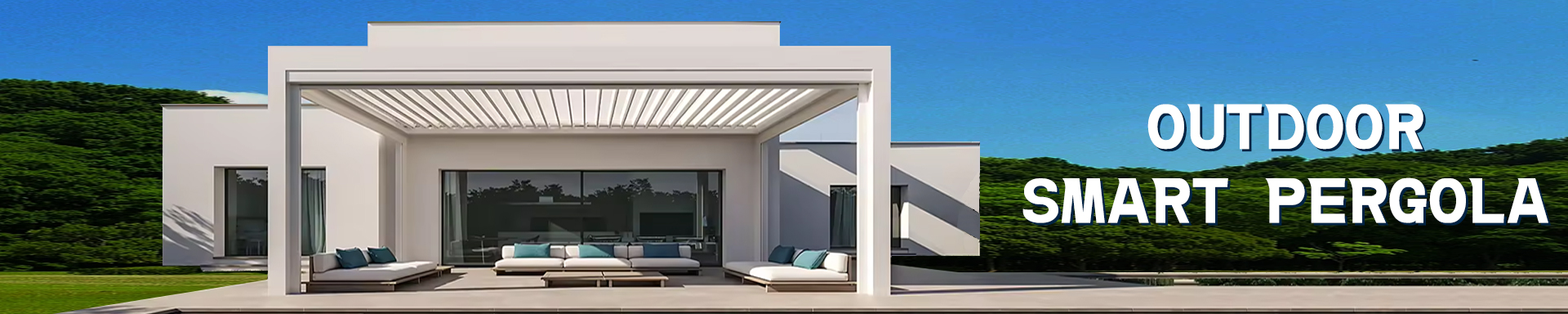
1. Material Quality and Weatherproof Design
A waterproof louvered pergola does not rely on a single feature to block rain. True weather resistance comes from how materials, surface treatments, and sealing systems work together as a complete structure. In commercial patios, rooftop terraces, and hospitality courtyards, long-term performance depends less on appearance and more on what sits beneath the finish.
Well-built louvered pergola systems integrate structural aluminum, corrosion-resistant hardware, and engineered sealing paths so water never accumulates where it shouldn’t. That design approach explains why high-quality installations continue operating smoothly after years of sun exposure, wind load, and seasonal rain cycles, even in coastal or high-humidity regions.
1.1 Aluminum and Stainless Steel Construction Benefits
Commercial-grade pergolas rely almost entirely on aluminum frames, reinforced with stainless steel fasteners at high-stress joints. Aluminum offers a high strength-to-weight ratio, which allows wide roof spans without excessive column sizes. In practical terms, a 6 × 4 meter aluminum structure can remain rigid under wind loads exceeding 120 km/h without visible deflection.
In mixed-use developments and residential terraces, aluminum pergola houses often integrate motorized louvers, lighting channels, and concealed drainage within the beam profile, something steel structures struggle to do without increasing weight and fabrication cost. Stainless steel then plays a supporting role at connection points, hinge pins, and load-transfer zones where friction and repeated movement occur.
| Material Component | Typical Application | Practical Advantage |
|---|---|---|
| Structural Aluminum | Beams, columns, louvers | Lightweight, corrosion-resistant, easy to machine |
| Stainless Steel (304/316) | Bolts, pins, brackets | High fatigue resistance, stable under moisture |
| Galvanized Steel | Temporary anchors | Lower cost, limited lifespan outdoors |
1.2 Corrosion Resistance and Powder Coating Standards
Surface protection defines how long a pergola maintains both function and appearance. High-quality systems use multi-stage powder coating, starting with chemical pretreatment, followed by electrostatic coating and oven curing at controlled temperatures. This process creates a dense, uniform layer that resists UV degradation, salt spray, and thermal cycling.
In coastal hotel projects, aluminum structures with 60–80 micron powder coating thickness typically show no blistering or color fading after five years of exposure. By contrast, thin or uneven coatings often crack at joint edges, allowing moisture to penetrate and corrode from the inside out. Once corrosion starts beneath the coating, surface repairs no longer solve the problem.
That is why premium outdoor systems treat coating not as decoration, but as a functional barrier designed to last through thousands of wet–dry cycles.
1.3 Waterproof Seals and Gasket Integration
Waterproof performance ultimately depends on how moving parts seal when closed. Precision-engineered louvers use EPDM or silicone gaskets fitted into blade edges and beam channels, creating controlled compression when the roof shuts. This prevents capillary water intrusion even during heavy, wind-driven rain.
In motor-driven systems such as an aluminum motorized pergola, installers typically follow a strict sequence to ensure sealing accuracy:
-
Level the frame within ±2 mm tolerance across the full span.
-
Install louvers from the drive side outward to maintain consistent blade spacing.
-
Adjust gasket compression until blades close flush without motor strain.
When done correctly, rainwater flows into internal gutters and exits through concealed downspouts inside the columns. The result feels less like an add-on canopy and more like a permanent architectural roof, especially in restaurants or commercial walkways where uninterrupted operation matters.
2. Louver Blade Functionality and Water Management
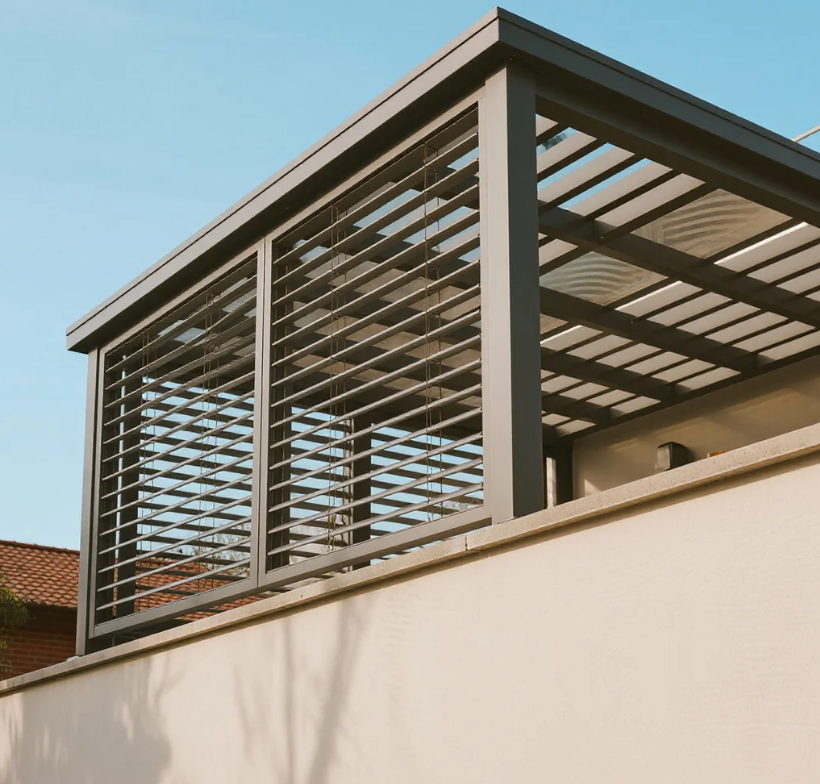
Waterproof performance does not depend on seals alone. The way louver blades rotate, overlap, and guide water determines whether rain drains cleanly or finds weak points. In a properly engineered louvered pergola, blade geometry, rotation limits, and drainage paths work together so water always moves with gravity instead of fighting it.
High-quality systems treat louvers as functional roof elements rather than decorative slats. That design mindset explains why some pergolas remain dry during heavy storms while others leak at low angles or during wind-driven rain.
2.1 Adjustable Blade Angles for Rain Deflection
Blade angle control directly affects how rain behaves on the roof surface. Most commercial-grade systems allow rotation between 0° and roughly 135°, but the critical waterproof range sits between 90° and 105°, where blades overlap tightly and create a continuous shedding surface.
During rainfall, installers typically calibrate the blades in three practical stages:
-
Set the fully closed position to ensure complete blade overlap with no visible gaps.
-
Fine-tune the stop angle so water flows toward the beam channels instead of pooling on blade edges.
-
Test under simulated rain to confirm runoff consistency across the full span.
Blade thickness and edge profile matter as much as angle. Louvers thinner than 1.2 mm tend to flex under water load, while thicker profiles maintain a stable water path even during sudden downpours.
2.2 Integrated Drainage Channels and Water Flow
Effective water management continues beyond the blades. Once rain reaches the beam, integrated drainage channels inside the frame must handle volume without overflow. Well-designed beams include sloped internal gutters that direct water toward vertical downpipes hidden inside the columns.
In commercial terraces measuring 5 × 6 meters, a properly sized drainage system typically handles over 50 liters of water per minute during peak rainfall. Problems arise when channels remain too shallow or when installers ignore micro-slopes inside the beam, causing water to backflow toward blade joints.
The key principle remains simple: water must move continuously from blade to beam to column without interruption. Any flat section invites pooling, noise, or leakage during extended rain.
2.3 Motorized vs Manual Louver Operation
Operation method influences long-term waterproof reliability more than most buyers expect. Manual systems rely on consistent user input, while motorized configurations maintain repeatable, calibrated closure every time, reducing sealing inconsistencies.
In larger outdoor dining areas, an aluminum motorized pergola often outperforms manual systems because synchronized motors close all blades evenly across wide spans. This uniform movement prevents uneven compression on gaskets, which commonly causes leaks in manually adjusted roofs.
Manual louvers still work well in smaller spaces, but once spans exceed 4 meters, motorized synchronization delivers more reliable water control, especially during sudden weather changes when fast, precise closure matters.
3. Structural Stability and Load Handling
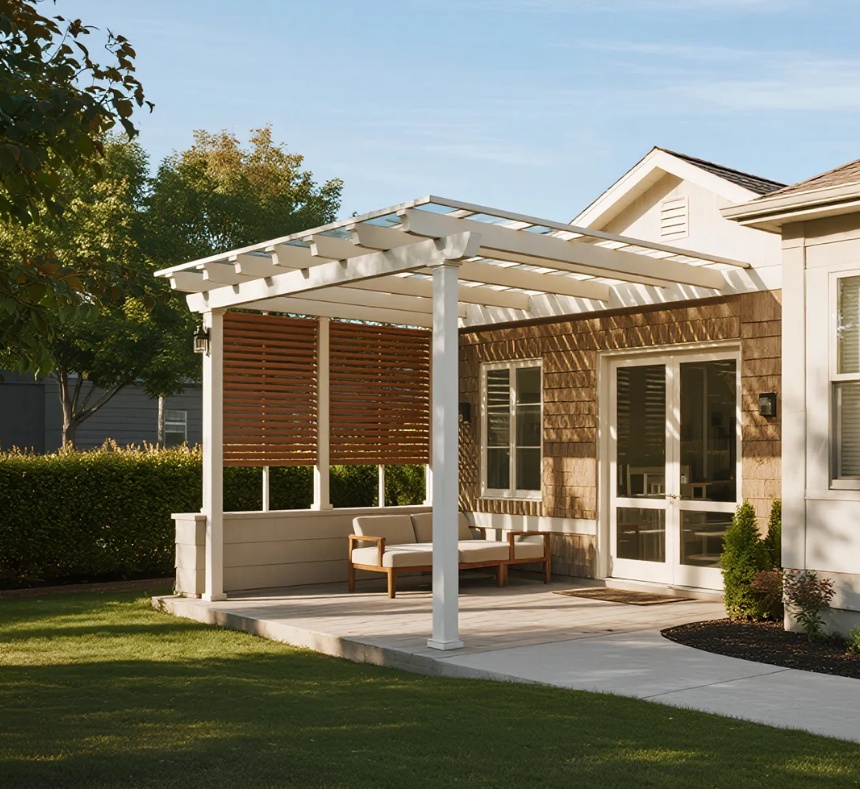
A waterproof roof means little if the structure beneath it flexes, shifts, or fatigues over time. Structural stability determines whether a pergola performs consistently under wind, rain, and long-term use. In well-engineered outdoor systems, load paths stay clear: forces travel from blades to beams, then into columns, and finally into the foundation without stress concentration or deformation.
For modern louvered pergola systems designed for commercial and high-end residential use, structural design focuses on predictable load behavior rather than decorative appearance.
3.1 Wind Load and Weight-Bearing Specifications
Wind load represents the most aggressive force acting on pergola structures, especially when louvers sit partially open. In coastal or high-rise environments, uplift pressure often exceeds downward gravity loads.
Well-designed systems typically account for:
-
Design wind speeds between 100–140 km/h, depending on regional codes.
-
Combined load scenarios where rainwater weight and wind pressure act simultaneously.
-
Dynamic loading caused by gusts hitting angled blades.
From a practical standpoint, blades should lock into a reinforced closed position during storms, transferring wind force directly into the beam rather than allowing rotational play. Any rotational tolerance above 1–2 mm at the blade pivot increases fatigue risk over time, especially on wider spans exceeding 5 meters.
3.2 Reinforced Frames and Column Support Systems
Frame rigidity depends less on material thickness alone and more on how beams and columns interact. Commercial-grade frames rely on internal ribbing, corner gussets, and load-spreading base plates to prevent localized stress.
In rooftop dining terraces or hotel courtyards, reinforced aluminum motorized pergola structures often use columns with wall thicknesses of 2.5–3.0 mm, paired with concealed steel reinforcement sleeves at connection points. This hybrid approach keeps the exterior corrosion-resistant while maintaining high axial strength.
Column spacing also matters. Spans over 6 meters without intermediate support demand deeper beams or additional internal stiffeners; otherwise, deflection becomes visible under sustained load.
3.3 Blade Thickness and Structural Reinforcements
Blade design influences both water control and structural performance. Thin louvers may look clean, but they deform under wind suction and repeated rotation cycles.
From field experience:
-
Blades under 1.2 mm tend to vibrate at moderate wind speeds.
-
Profiles around 1.4–1.6 mm maintain shape and sealing integrity under load.
-
Reinforced blade ends reduce torsion at the motor drive point.
To put this into perspective, a 5 × 4 meter installation with reinforced blades and frame stiffeners can withstand over 120 kg of distributed load without measurable deflection. Structural reinforcement at the blade level directly extends service life, especially in locations exposed to frequent storms or temperature swings.
4. Control Systems and Automation Features
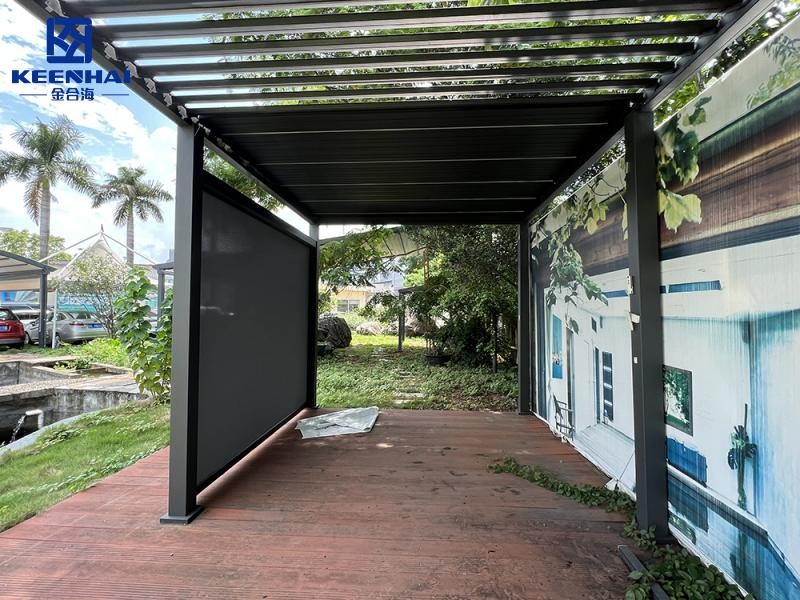
Control systems define how a pergola actually performs day to day. Good automation does not just add convenience; it protects the structure, extends component life, and stabilizes performance under changing weather. In high-quality louvered systems, control logic, motor torque, and accessory integration work as a single coordinated system rather than isolated add-ons.
4.1 Smart Sensors for Rain and Sunlight Detection
Smart sensors act as the first layer of protection. Rain sensors detect moisture within seconds and trigger automatic blade closure before water accumulates on the roof surface. In properly configured systems, the response delay typically stays under 30 seconds, which prevents pooling even during sudden downpours.
Sunlight sensors work differently. Instead of reacting to brightness alone, advanced units measure solar intensity and angle, adjusting blade tilt to balance shade and airflow. In large outdoor dining areas using a modern louvered pergola system, this automatic adjustment keeps interior temperatures stable without manual intervention, especially during peak midday exposure.
4.2 Motor Integration and Smooth Blade Operation
Motor performance directly affects reliability. A well-matched motor delivers consistent torque across the entire rotation range, avoiding jerks at start or stop. For spans wider than 4 meters, motors typically operate within a torque range of 40–60 Nm to maintain synchronized blade movement.
During installation, technicians follow a clear sequence:
-
Mount the motor housing with vibration-damping pads.
-
Align the drive shaft to keep angular deviation below 1°.
-
Calibrate end positions to prevent over-rotation stress.
Smooth blade motion reduces wear on linkages and keeps sealing edges intact, which becomes critical in automated aluminum pergola structures exposed to frequent weather changes.
4.3 Optional Accessories: LED Lighting and Drainage
Integrated accessories should feel like part of the structure, not afterthoughts. LED lighting strips often sit inside beam recesses, protected from direct moisture while providing uniform illumination. In commercial terraces, neutral white lighting around 3000–4000K avoids glare and maintains visual comfort.
Drainage systems work quietly in the background. Internal gutters channel water from closed blades into concealed downpipes within the columns. When lighting wiring and drainage paths share coordinated routing, maintenance access stays simple and long-term reliability improves, even in high-traffic outdoor environments.
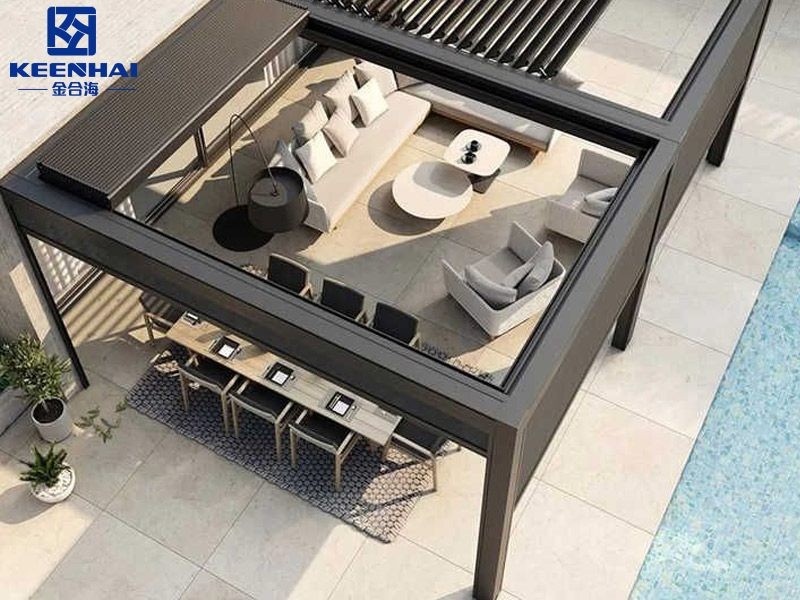
5. Installation Considerations and Site Adaptation
Installation quality often determines whether a system performs as designed or slowly develops alignment, drainage, or control issues. A well-designed louvered pergola still depends on how accurately the site conditions match the structural and mechanical requirements. This section focuses on the practical decisions installers make on real projects, not theory.
5.1 Surface Preparation and Mounting Requirements
Surface conditions directly affect long-term stability. Concrete slabs should reach a minimum compressive strength of C25 (≈25 MPa) before anchoring, with a flatness tolerance within ±3 mm over 2 meters. Uneven surfaces introduce torsion into the columns, which eventually impacts blade rotation accuracy.
Typical preparation steps follow a clear order:
-
Verify slab thickness (commercial projects usually require ≥150 mm).
-
Mark anchor positions using the factory base-plate template.
-
Drill anchor holes to the specified depth, keeping vertical deviation under 2°.
On rooftop terraces and reinforced decks, installers often add steel spreader plates to distribute loads evenly, especially when installing a full-span louvered pergola system exposed to wind uplift.
5.2 Roof Span and Layout Customization
Span length and layout determine whether the structure needs intermediate supports or reinforced beams. Single-module spans typically remain within 3–4 meters, while larger commercial layouts combine multiple bays with shared gutters and synchronized blade control.
In practice, installers adjust layouts based on:
-
Column placement constraints from existing utilities
-
Drainage direction relative to building slopes
-
Clearance for lighting, heaters, or ceiling fans
Custom layouts reduce visual clutter while preserving structural symmetry, which becomes especially important in restaurants or hotel courtyards where aesthetics matter as much as performance.
5.3 Compatibility with Existing Outdoor Spaces
Most projects integrate pergola systems into already-built environments rather than empty sites. That means working around stone paving, wooden decks, glass façades, and pre-installed drainage lines. Accurate site measurements prevent conflicts with door swing paths, window shading angles, and existing roof overhangs.
In mixed-use spaces, installers often adjust column offsets by 50–100 mm to align with façade elements without compromising load paths. Good site adaptation allows the structure to look intentional rather than retrofitted, preserving both usability and architectural flow across the outdoor area.